Is FHA better than conventional financing when you're buying a home?
That's a question I hear from buyers quite often, and the answer isn't as simple as you might think.
It really depends on you, your financial situation, and what you're trying to accomplish.
Let's start with FHA financing.
One of the reasons FHA loans are popular is that qualified buyers may be able to purchase a home with as little as three-and-a-half percent down.
FHA financing can also be an option for buyers whose credit or financial profile may make conventional financing more difficult.
But there's something important I want you to understand.
A lower down payment doesn't automatically mean it's the better loan.
FHA loans require mortgage insurance, so you need to look at your total monthly payment and not just how much money you're putting down.
Now let's talk about conventional financing.
Depending on the loan program, some buyers may be able to purchase with as little as three percent down.
For buyers with stronger credit, conventional financing can sometimes offer a better overall financial option.
If you put less than twenty percent down, you may have private mortgage insurance. But depending on the loan and your circumstances, that insurance may eventually be removed.
This is why I don't like to tell buyers that FHA is better than conventional, or that conventional is better than FHA.
I want you to compare the actual numbers.
And there's one more financing option we need to talk about, especially here in San Diego.
VA financing.
If you're an eligible veteran or qualifying service member, please don't overlook your VA home loan benefit.
Eligible VA buyers may be able to purchase a home with no down payment, and VA loans don't require monthly mortgage insurance.
There may be a VA funding fee, although some borrowers are exempt.
So which loan is better?
FHA, conventional, or VA?
The answer is the loan that works best for your individual financial situation.
When you talk with your lender, don't just ask how much you qualify for.
Ask them to show you the different options available to you.
Compare the interest rate.
Compare your total monthly payment.
Compare your down payment and closing costs.
Look at mortgage insurance.
And most importantly, look at what you're comfortable paying every month.
Especially here in San Diego, where home prices can be significant, the way you finance your purchase can make a big difference.
And remember, you don't have to figure all of this out by yourself.
Your lender can help you understand the financing, and as your real estate broker, my job is to help you understand the real estate side of the transaction and negotiate on your behalf.
I'm Minnie Rezlawski with The 24k Real Estate Group and REMAX City Real Estate.
If you're thinking about buying a home anywhere in San Diego County, I'd be happy to talk with you about where you are today and help you determine your next step.
And if you're not ready to buy right now, that's okay too. Sometimes the first step is simply finding out what you need to do so you'll be ready when the time is right.
Follow me on Facebook and Instagram for more San Diego real estate information.
And if you're watching on YouTube, subscribe to my channel and turn on notifications so you don't miss my next Morning Market Insights With Minnie.
I'll see you next week.
FHA vs. Conventional vs. VA Loans: Which Is Better for San Diego Homebuyers?
If you're thinking about buying a home in San Diego, one of the first decisions you'll make isn't which house to buy.
It's how you're going to finance it.
One of the questions I hear from buyers is:
"Is FHA better than conventional financing?"
My answer is usually: It depends.
There isn't one mortgage program that's automatically better for every buyer. Your credit, income, available cash, monthly debts, military eligibility, the property you're purchasing, and even your future plans can influence which loan makes the most sense.
And here in San Diego County, where home prices can be significant, choosing the right financing can have a major impact on both the cash you need to purchase and your monthly housing payment.
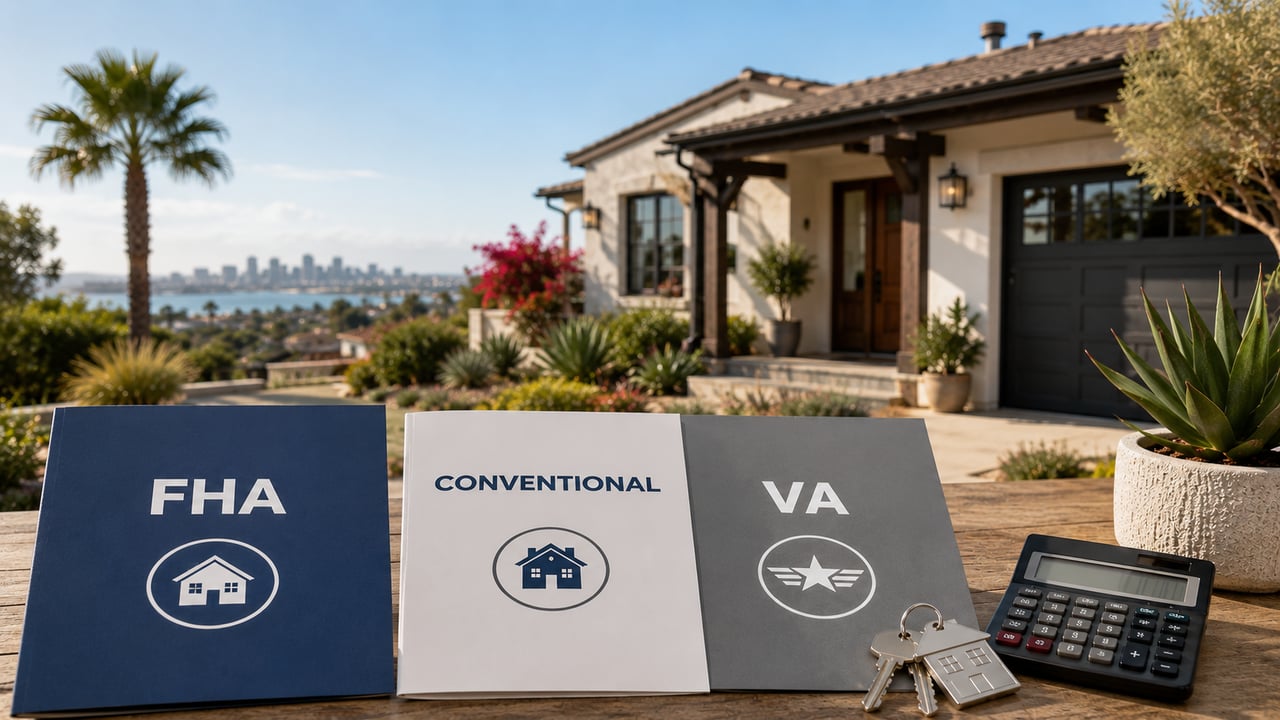
Let's look at three of the most common options: FHA, conventional, and VA financing.
What Is an FHA Loan?
FHA loans are mortgages insured by the Federal Housing Administration.
One of their biggest advantages is the relatively low minimum down payment. Qualified buyers may be able to purchase with as little as 3.5% down.
FHA financing may also provide an opportunity for borrowers whose credit or financial profile makes qualifying for certain conventional programs more difficult.
But here's something I always want buyers to understand:
The lowest down payment doesn't necessarily mean the best loan.
FHA loans generally include both an upfront mortgage insurance premium and annual mortgage insurance premiums that are typically paid as part of the monthly mortgage payment.
Depending on your loan terms, that mortgage insurance can remain for a significant period of time.
That's why buyers shouldn't compare loans based only on the down payment.
You need to look at the entire financial picture.
What Is a Conventional Loan?
A conventional mortgage isn't insured by the federal government.
Depending on the loan program and buyer qualifications, some conventional programs may allow qualified borrowers to purchase with as little as 3% down.
Conventional financing can be particularly attractive to buyers with stronger credit profiles.
If you're putting less than 20% down, however, you may be required to pay private mortgage insurance, commonly called PMI.
One potential advantage is that conventional PMI may eventually be eligible for cancellation when certain requirements are met.
That can make a significant difference over the life of homeownership.
But again, don't assume conventional financing is automatically less expensive.
Your interest rate, PMI cost, down payment, closing costs, credit profile and other factors all matter.
FHA vs. Conventional: Which Is Better?
This is where buyers sometimes make the mistake of looking for a universal answer.
There isn't one.
Instead, I recommend asking your lender to show you the actual numbers for each program for which you qualify.
For example, compare:
- Your required down payment
- Interest rate
- Principal and interest payment
- Mortgage insurance
- Property taxes
- Homeowners insurance
- HOA fees, if applicable
- Estimated closing costs
- Total estimated monthly housing payment
- Estimated cash needed to close
Seeing those numbers side by side can make the decision much easier.
A loan that initially appears more attractive because of a smaller down payment might result in a higher monthly payment.
Another loan may require more money upfront but provide a lower monthly housing expense.
The important question isn't simply:
"Which loan is better?"
It's:
"Which loan is better for me?"
Don't Forget About VA Financing
There's another financing option that's especially important to discuss in San Diego County.
VA financing.
With our large military and veteran community, I never want an eligible buyer to overlook the VA home loan benefit.
Qualified veterans, active-duty service members and certain other eligible borrowers may be able to purchase a home with no down payment.
VA loans also don't require monthly mortgage insurance.
There can be a VA funding fee, although some eligible borrowers may be exempt.
For the right buyer, VA financing can be an extremely valuable benefit.
I've seen buyers assume conventional financing would make their offer more attractive without first fully evaluating their VA option.
Before making that decision, understand what you're giving up.
Your financing should be evaluated based on your financial goals — not simply on assumptions about what type of loan sounds better.
Look Beyond the Interest Rate
Buyers naturally focus on mortgage rates.
Of course the rate matters.
But the lowest advertised interest rate doesn't necessarily tell you which loan is the least expensive.
You also want to consider points, lender fees, mortgage insurance, down payment requirements and total cash needed at closing.
Ask your lender to explain the difference between the interest rate and APR and to provide detailed Loan Estimates when appropriate so you can compare your options more accurately.
A small difference in rate can affect your monthly payment, but so can mortgage insurance and the amount you finance.
Look at the entire loan — not one number.
Your Comfortable Payment Matters More Than Your Maximum Approval
Here's another conversation I frequently have with buyers.
Your lender may tell you the maximum amount you're qualified to borrow.
That doesn't mean you should necessarily spend that amount.
There's a difference between:
"How much can I qualify for?"
and
"How much am I comfortable paying every month?"
Your housing payment is only one part of your financial life.
You may also have car payments, childcare, student loans, travel, retirement goals, family obligations or other expenses that aren't fully reflected by a mortgage approval.
I want my buyers to think beyond getting the keys.
You should still be comfortable living your life after you become a homeowner.
Seller Concessions Can Be Part of the Conversation
In a market where buyers may have more negotiating leverage on certain properties, financing and negotiation can sometimes work together.
Depending on the property, seller motivation, competing offers, loan program and contract terms, it may be possible to negotiate seller concessions toward allowable buyer closing costs.
That money might help with certain closing expenses or, in some transactions, help make an interest-rate buydown possible.
It isn't something a buyer should automatically expect.
Every property and negotiation is different.
But this is exactly why your financing strategy and real estate strategy should work together.
Your lender handles the mortgage side.
As your real estate broker, my role is to help you evaluate the property, understand the transaction, structure your offer and negotiate on your behalf.
What Should You Ask Your Lender?
Instead of calling a lender and asking only, "How much can I qualify for?" try asking:
"Can you show me my FHA, conventional and VA options, if I'm eligible, and compare the estimated cash needed and monthly payment for each?"
Then ask questions.
What happens to my payment if I put more money down?
How much mortgage insurance am I paying?
Can that mortgage insurance eventually be removed?
Would paying points make sense?
How much cash should I keep in reserves after closing?
Would a seller credit help with my closing costs or financing strategy?
These conversations can help you make a much more informed decision.
Buying a Home in San Diego? Start With the Numbers
Whether you're considering a home in Chula Vista, Bonita, Downtown San Diego, La Mesa, East County, South Bay, North County or elsewhere in San Diego County, your home search should begin with a clear understanding of your financing.
You don't necessarily need to be ready to buy next week.
Sometimes the first step is simply finding out where you stand.
Maybe you're ready now.
Maybe you need several months to improve your credit, reduce debt or save additional money.
That's okay.
Once you know what needs to happen, you can create a plan.
After decades in San Diego real estate, one thing I know is that successful homebuyers aren't necessarily the people who started out in the strongest financial position.
They're often the people who asked the right questions, understood their options and prepared before making their move.
FHA, Conventional or VA: Let's Look at Your Options
So, is FHA better than conventional financing?
Sometimes.
Is conventional better than FHA?
Sometimes.
And if you're VA eligible, could VA financing be the strongest option?
Absolutely — depending on your individual circumstances.
There isn't one answer for every buyer.
That's why I encourage buyers to compare the numbers and make a decision based on their own financial situation and homeownership goals.
If you're thinking about purchasing a home anywhere in San Diego County, I'd be happy to talk with you about where you are today and help you understand your next steps.
Even if you're not ready to purchase right now, getting the right information today can help you become a homeowner tomorrow. Please follow me for more real estate information and updates on Facebook or Instagram and Subscribe on Youtube.
Minnie Rzeslawski
The 24K Real Estate Group
RE/MAX City Real Estate
San Diego, California